Showing posts with label ACCOMMODATION - Dominica. Show all posts

Sunday, May 22, 2011

Morne Trois Pitons, then Harmony Villa

Morne Trois Pitons (mountain of three peaks) national park, located in the centre of Dominica, is named after the island's second highest mountain, which is just over 4000 feet. A dormant volcano, it has its lower slopes covered in rainforest and its highest in low, scrubby and mossy elfin woodland. Apart from the volcano itself, this forested and mountainous park contains many of Dominica's most impressive natural features, including several lakes (Boiling, Boeri, Freshwater) and waterfalls (Trafalgar, Middleham, Emerald Pool). It became a World Heritage Site in 1997.

Towards the end of my stay in Dominica, two things still remaining on my list were Emerald Pool and Morne Trois Pitons, so I had to get up to the mountains, rain or shine.

By now I was a pro at catching local minibuses around the island, and I sat in the front of one of these, talking to the friendly driver who was heading over to Rosalie on the windward side of the island. I was lucky to catch his bus he said. If he hadn't stopped to buy bread, I would've missed him.

I got dropped off at the Emerald Pool junction and walked down a country road to the entrance. From here, the trail led through beautiful green forest, where the trees were some of the oldest and largest I'd seen in Dominica (strong hurricanes, such as David in 1979, are capable of knocking down whole forests, thus trees in the Caribbean are rarely as large as those seen in South America, which is out of the path of these storms).


By the trail, there was a tumbling river.


It cascaded over a rock ledge into a pool below. Even on this mainly overcast day, the emerald colour of the pool showed up. Another impressive waterfall on an island with so many.


From here, it took just over an hour to get back to the start of the Trois Pitons trail (starting near the Pont Casse roundabout) on a forest trail over roughly paved rocks and crossing several rivers. This section is part of the Waitukubuli trail which traverses Dominica from south to north.

Reaching the road, I could see that the peaks were covered in dense clouds, but being my last chance to climb the mountain, I went for it.


It was a steep two-hour climb up a well-defined trail through dense forest. Towards the top, ropes helped get up eight-metre high rock faces. And then the final part was a surreal and almost impenetrable world of bogs, thick moss, slippery rock boulders and low contorted branches. 


On the summit, I was enveloped in cold clouds being swept over me at high speed. On a clear day, one would be able to see the entire island and over to Guadeloupe and Martinique, so this would have to remain an excuse for a return trip to the island.  

As I creaked and slipped my way down the mountain, there were infact a few teasing openings in the clouds below, giving me a view of the thick forests of the central part of the island.


Back on the country road again and a couple hundred metres past the roundabout in the direction of the village of Layou, the first house on the right is Harmony Villa.
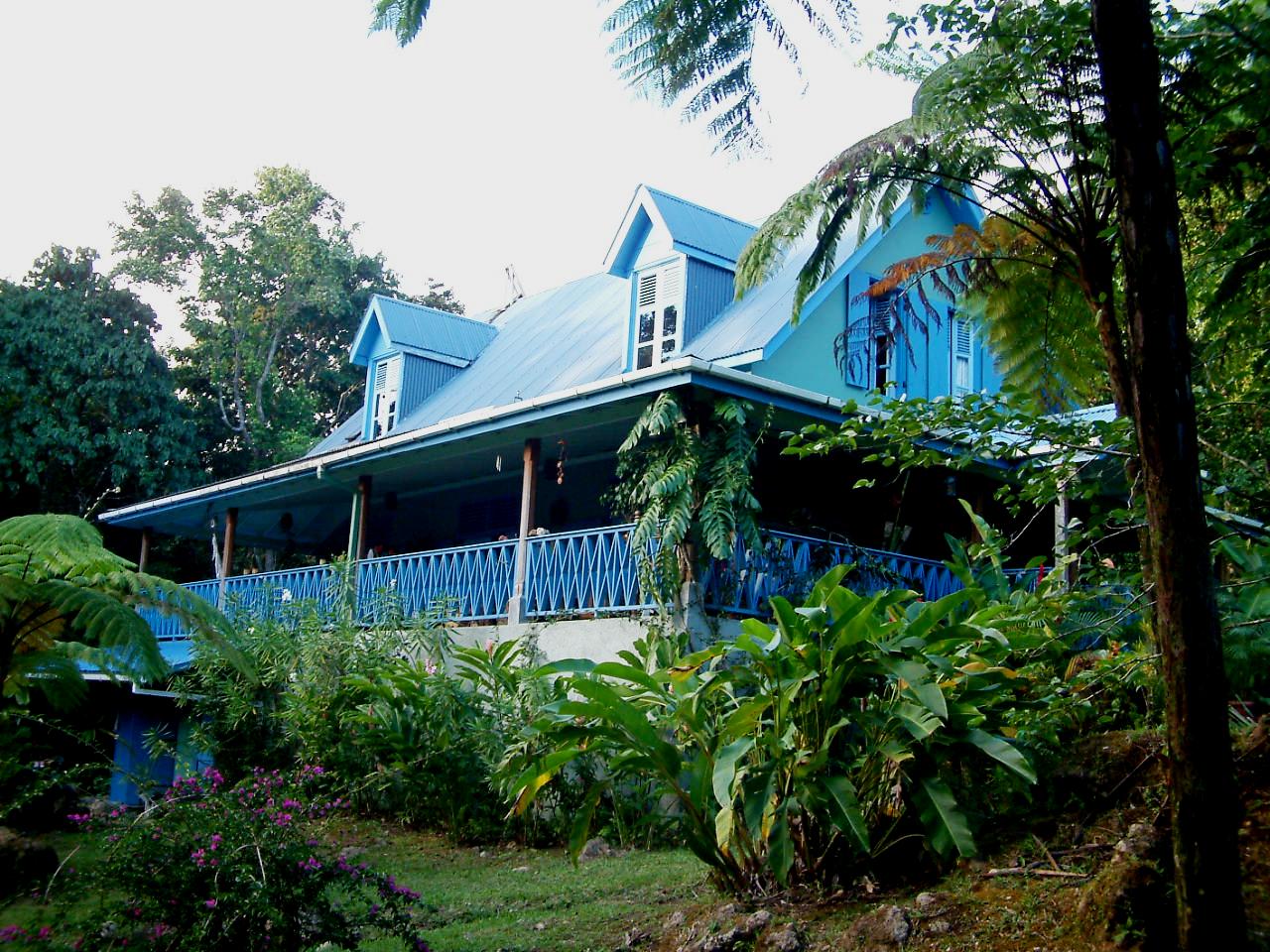

Built in a colonial style, it has large verandas and a cool mountain garden, filled with tree ferns and wild ginger. After a strenous day of walking in the mountains such as today's, I would have a long hot shower, then sit in an armchair on the veranda with a nice big pot of tea.

And, for exploring the island, the location is perfect. Within a hand's throw (or more appropriately, a walk) is Morne Trois Pitons, Emerald Pool and Jacko Falls. Carrying on the Layou road by car or minibus, one would reach the central west coast. Back at the roundabout one road heads to Roseau, the southwest and southeast of the island; another to Rosalie and the Carib Territory on the east coast and another to the northeast and airport. So, it couldn't be more central. 


The spacious interiors give a sense of this being a luxury mountain retreat. From the veranda, there are french doors leading into the villa, with its high cathedral ceiling and central kitchen. Off this, there is an indoor dining area and a lounge with a wood-burning stove. There is also a library, study and studio, used for artists and renewal sessions.

Bedrooms are very comfortable, with large beds and windows which let in plenty of natural light and lend a view onto the two acres of gardens and forest.


Back on the wonderful veranda, there is a large table ideal for al-fresco dining.


Harmony Villa, with its four bedrooms, sleeps eight adults. There are also fold-out and day beds which could sleep up to four children. 

Rates vary from US$250 per night for the use of one bedroom up to US$550 for four bedrooms. For each additional person (after eight), the charge is US$40 per night. Rates exclude the 10% service charge. Minimum stays are two nights. There are discounts for week-long stays.

Further information on www.harmonyvilla.com

Picard Beach

Picard Beach Cottages are set in gardens just behind a long sandy beach in Prince Rupert Bay, on Dominica's northwest coast. It's in a quiet location and the view is up the bay to Portsmouth and across to the historic Fort Shirley (from where the British defended the island against invading French troops) in Cabrits national park. In the distance, part of Guadeloupe can be seen on clear days, emerging to the left of the twin peaks of Cabrits.


I arrived there in a tropical downpour and as I dried off in the reception area, a  happy French couple were telling me that the previous night they saw a Leatherback turtle come ashore to lay its eggs (the season runs from April to September). Just up the bay, they had been using the Cabrits dive centre to scuba in spots around the northwest, and had gone off exploring on their own around the island. Nearby is Mount Diablotin, Dominica's highest peak at over 4000 feet, the Syndicate trail from where there's a good chance to see the endangered Sisserou parrot (featured on Dominica's national flag), Indian River for kayaking, along with a beautiful coastline and hilly forested countryside. On the opposite coast is Calibishie and the Carib Territory, and Roseau is on the coast road heading south.

We said goodbye and five minutes later the rain stopped as abrubtly as it had started. 

As I walked around the gardens, water dripped off tropical plants, as an intense sun dried off everything else.


The eighteen cottages are set under shady palms and a huge Samman tree, with forest behind. Some are just behind the beach, while others are nestled in lush gardens. Built of wood in a simple style, they were conceived with the self-catering in mind, each having a kitchenette and dining area, along with double en-suite bedrooms and a veranda. Next door is the Le Flambeau beachside restaurant which serves breakfast through to dinner. And there is also a natural botanicals spa in a cottage by the beach.


While filming Pirates of the Caribbean, the crew and cast stayed at Picard Beach Cottages.


Veranda of a garden cottage.


Veranda of a beach cottage.


A good place to relax and read a book.


Le Flambeau beach restaurant.


Flower of an African tulip tree on the black sands.


A stay here is ideal for those who simply want to relax by the beach or to use it as a base for diving in the northwest and exploring the island.

Cottages cost between US$120 and US$220, depending on season and grade of accommodation.

For further information, please visit www.picardbeachcottages.dm
For the related article about Portsmouth, Cabrits and the Northwest, please see Northwest Coast

Saturday, May 14, 2011

Black and White Sands of Pointe Baptiste

While in Dominica, I was reading Black and White Sands, a fascinating and humorous account of colonial life on the island from the 1930s to early 1960s. Written by Elma Napier, who with her husband and children moved to the island from England in 1932, it talks of their bohemian lifestyle in the then remote northern district, where they built a wooden house on a clifftop, above black and white sand beaches, went exploring the mountains, forests and rivers of the interior, learnt the habits of the locals and entertained artists, writers and aristocrats. Elma went on to become the first woman to serve in any West Indian parliament, and during this time she visited Amerindian villages in the Carib territory on horseback and supported the otherwise left-out villages of northern Dominica.

By chance, I found out that the Napier home at Pointe Baptiste is still in the family and rented out as a holiday guest house. A couple of days later, I took a minibus up the west coast from Roseau to Portsmouth and then another across the northern tier to Pointe Baptiste, just beyond the coastal village of Calibishie.

When I arrived, I met Alan Napier (grandson of Elma), who was busy cutting open cocoa pods to remove the beans. After being brought up in Turkey and France, with summer visits to Dominica, he moved to Pointe Baptiste two years ago to manage the estate.

As he showed me around, he recounted stories of family adventures and pointed out features of the house and garden which I recognised from the book.

On the path to the main house was a bike and trailer, used by Alan to collect provisions from the village.


The house, built in colonial island style, is entirely of wood, with massive beams inside, shingle sides outside and galvanized roofing.


At the front, it is shaded under a large Ylang Ylang tree, native to Indonesia.


Its fragrant flowers are distilled into an essential oil for use in aromatherapy. Interestingly, Alan mentioned that at Pointe Baptiste they also make their own oil from bay and cinnamon leaves.


The house, with its large veranda and shuttered windows, is surrounded by gardens originally planted by Lennox, Elma's husband (who also designed the house). It looks out to sea, over a red rock headland and towards the islands of Guadeloupe, Les Saintes and Marie-Galante.


Inside, it felt as if little had changed here since the 1930s, with the original woodwork, furnishings, books and artwork. Its a real island heritage and wonderful to see that some things don't, and shouldn't, change.


Just outside, there was a small vegetable garden, where I was surprised to see basil amongst tropical herbs.


And all over the place, including in a separate orchard, there were tropical fruit- mangos, guavas, custard apples, passionfruit to name a few. Below is a soursop, similar to a custard apple but less sweet and more fragrant, which has become my favourite fruit of the islands.


There are also two wooden cottages, with their own kitchen, for a couple. This infact was the original cottage, in which the Napiers lived while the main house was being built.


Alan and I wandered along a path, through coastal forest, until we reached the top of a cliff. The view was magnificent. This is the white sand beach, with its shallow waters ideal for snorkelling.


Then we walked down another forest path, in this 25 acre property, which led onto the red rock headland.


Peering into a large eroded gully, Alan pointed out a cave which they had once dug out. It reminded me more of Petra than anything else.


Across the sheltered bay, we could see the main house above the cliffs and amongst trees. Below was black sand beach, which can be reached via a separate trail.


At the far end of the headland, we looked down onto crashing waves, where local fishermen sometimes venture.


In the distance were the mountains and high cliffs of extreme northeastern Dominica.


The red rock headland, with its intense colour is unlike anything else in Dominica, where the black and dark grey of volcanic eruptions predominate.


Back on the 70 foot veranda, as we talked and looked out to sea, Alan offered a memorable lunch made entirely from produce grown on the estate- boiled bread nuts (which reminded me of chestnuts) dipped in olive oil, plantain juice and passionfruit. It was amazing to think that Elma, Lennox and the children were probably doing exactly the same back in the 1930s, from this very same veranda.


At Pointe Baptiste Estate, the 1930s main house can be rented out for US$270-350 per day (depending on season), for six people, including taxes and a cook. Likewise, the two cottages, each for two people are US$80-110 per day. For further information and reservations, please see www.pointebaptiste.com

Friday, May 13, 2011

Cocoa Cottages and CocoJazz

The minibus was winding its way into the forested mountains inland from Roseau, and then I suddenly saw the sign for Cocoa Cottage.

"Stopping" I shouted my orders to the driver, from the back of the bus, in true Dominican fashion.

I squeezed past fellow passengers who were heading up to the nearby village of Trafalgar, and went in to find Iris, owner and manager.


Walking down the pathway, I could already see how the place got its name. There were cocoa trees everywhere. Their dividing trunks and shady canopies lined the way.


There were even some cocoa pods ready for picking.


From the outside, I could see that the lodge was built using local materials- volcanic rocks, wood and galvanized roofing, all so typical of the island.


The lodge is orientated to look out over the steep forested hills and valleys.


Alongside the main lodge, there is a two storey bungalow, also called the honeymoon suite. Views are equally spectacular and like the main lodge, there are porches on which to sit and enjoy the serene nature of the place.


I wandered around the gardens, finding more cocoa trees as well as large stands of tree ferns and palms.


Then I took a steep path bordered by heliconia down into the cool shady forest.


At the bottom, I found a tumbling stream and a stand of banana palms, whose leaves were lit up by the sun.


Inside the lodge and bungalow, there is the same feeling of being immersed in nature. Through large open windows and French shutters, cool interiors of wood and stone receive mountain breezes and the sound of crickets, tree frogs and buzzing hummingbirds.


There are books everywhere, and I particularly loved this collection of 1930s National Geographics.


The architectural design has been artfully conceived. Above the downstairs lounge and dining areas, the upstairs bedrooms each have their own style and character. What they have in common are porches with mountain and forest views, the use of wood and stone, attention to detail and local works of art on the walls.


Around the lodge, there are secluded seating areas, from where you can hear the stream and look out over the mountains.


And everywhere there are artistic touches. I liked the way this wooden cable spool has been painted and turned into a coffee table.


The kitchen and dining set up is great, built with open sides and leading straight out into the gardens. There is a large round dining table and Iris also applies her artistic talent to the cooking. As she prepares dinner, using fresh local herbs, spices, fruit, vegetables and seafood, guests can chat, drink a glass of wine and gain a free lesson as an island chef. The atmosphere is very relaxed.


Something which grabbed my attention was everything related to cocoa.

In the lodge, there is a sort of small museum, explaining all aspects of this crop. For example, I learnt that there are three species of cocoa tree- Criollo from Central America and Venezuela, Forastero from the high Amazon and Trinitario from Trinidad. And the process of preparing cocoa paste involves many stages- harvest of the cocoa pods, sweating and fermentation of the white cocoa fruit (traditionally inside shallow wooden boxes covered with a banana leaf), removal and sun drying of the beans, roasting to release the rich aromas and flavours, cracking of the shells and winnowing, followed by crushing of the nibs into the thick paste which can then be used for making chocolate.

This is everything that Iris does when preparing her own dark CocoJazz chocolates, blended with local cinnamon, coffee, ginger and orange. I tried some- they out of this world, and just as good as the best artisanal chocolates I've had in Brussels. What's more, it couldn't get more local or ecological than this. I was eating something produced from a tree literally yards away.


It also made me feel good to read up about all the health benefits of pure cocoa (the unhealthy part of eating chocolate comes from all the saturated fats, sugars and additives found in mass produced milk chocolates).

This list of healthy ingredients in pure cocoa included being a top source of antioxidants (exceeding, by far, almost every other fruit, nut and vegetable), and containing  a range of minerals- magnesium, calcium, potassium, zinc, iron, copper, manganese and sulphur. It also contains oleic acid, a monounsaturated fat, which is found in olive oil. In addition, cocoa has compounds that stimulate the release of endorphins in the brain. For example, tryptophan causes the release of serotonin, an anti-depressant and theobromine is what leads to the sense of physical and mental relaxation.

But in case all of that won't convince you to consume more cocoa and dark chocolate, perhaps the sign outside Cocoa Cottages will.


Cocoa Cottages, located on the mountain road just below the village of Trafalgar, has six double rooms. On a single occupancy basis, they cost US$100 and for a double occupancy $125, excluding the 10% island taxes. The 7th night is free and there is a 20% discount, if staying two or more nights, for the canyoning excursions which they also organise. For further information on Cocoa Cottages and the canyoning, please visit www.cocoacottages.com